

- Problem: Calendar age as risk proxy.
- Solution: Prioritize circuits by true risk.
- Benefit: Make planned work more productive, avoid emergency costs, decrease SAIFI/SAIDI.
A five-year vegetation cycle is easy to explain, easy to budget, but increasingly hard to defend as the best use of money. Vegetation-related impacts account for more than 20% of U.S. power-system outage incidents, according to the U.S. Department of Energy (DOE). Yet trees do not grow, weaken, or fail on a five-year clock. Species, health, canopy density, weather exposure, terrain, prior trimming, and conductor geometry make every circuit different.
That mismatch creates two expensive errors:
- Slow-growth, healthy areas may be trimmed before they need work, and
- Fast-growth or declining trees may become outage threats years before their scheduled turn.
The real alternative to a fixed cycle is not indiscriminately trimming the entire system more often. It is assessing risk more often, then intervening only where the evidence warrants it.
The Cost of Uniformity
A 2025 Michigan Public Service Commission audit provides a rare look at the economics. After DTE trims a circuit, modeled outage reduction declines from 40% in year one to 30% in year two, 25% in year three, 8% in year four, and zero in year five. Moving the entire distribution system from a five-year to a four-year cycle, however, would add roughly 1,400 circuit miles of annual work and an estimated $40 million to $50 million per year.
That frames the traditional choice: accept fading reliability late in the cycle or buy another blanket year of trimming. Circuit-risk analysis creates a third option. Keep low-risk zones on the longer interval while accelerating only the zones whose measured conditions indicate that risk is rising.
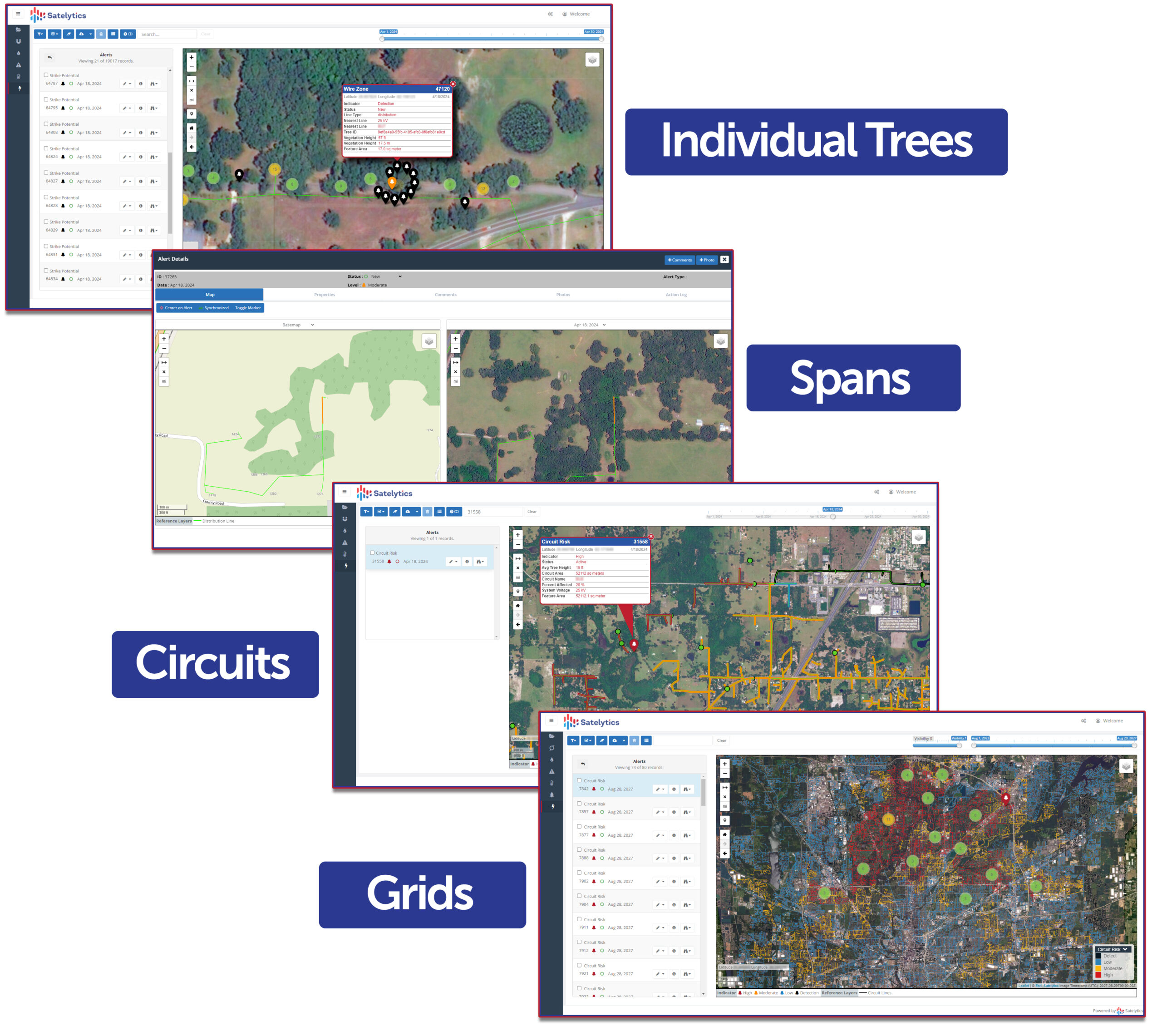
Circuit risk analysis refines standard calendar-based trim cycles, yielding cost savings.
The value of avoiding unnecessary work grows quickly because vegetation treatment is expensive. DOE’s 2024 resilience guide reports illustrative average cycle costs of about $11,000 per distribution mile and $42,000 per transmission mile for Duke Energy Florida’s 2023–2025 program; the same guide shows wide variation among utilities, confirming that local conditions and scope matter. At those magnitudes, preventing even a modest number of low-value crew miles can fund substantial monitoring, analysis, and high-priority mitigation elsewhere.
Evidence Beats Mileage
Lake Region Electric Cooperative offers a useful proof of mechanism. After adopting data-supported vegetation planning, it reduced vegetation-management cost from nearly $2,400 to $500 per mile and changed a $7.5 million, five-year system cycle into a $2 million, four-year cycle. Tree-related outages fell 30%, total outage hours fell 45%, and the share of crew time spent reacting to problem areas dropped from nearly 50% to less than 10%.
Those results should not be copied into another utility’s business case as a guaranteed forecast. They demonstrate something more important: shorter cycles and lower total cost are not contradictory when better information reduces workload and reactionary effort. The financial target is not “more trimming.” It is less searching, less low-value cutting, fewer emergency mobilizations, and more planned work at the locations that carry the greatest expected consequence.
Integrated vegetation management (IVM) strengthens the lifecycle case. A TREE Fund analysis of utility rights-of-way found that an IVM strategy using selective herbicide treatments had a 20-year present-value cost 55% lower than repetitive mowing. That result reinforces the economic principle: maintaining compatible, low-growing plant communities can reduce repeat work and future pressure from tall-growing species.
Risk Outside the Corridor
A calendar cycle also struggles with the threat that dominates transmission experience: fall-ins from outside the maintained right-of-way. NERC recorded 18 such sustained outages in 2023, versus 31 in 2022 and a five-year average of approximately 29; 83% of the 2023 events were associated with weather. A utility can have a clean corridor and still own significant exposure from a tall, unhealthy tree beyond its routine clearing limits.
That is why tree health, height, canopy density, and species matter together. A fast-growing tree near a wire zone presents a different probability than a healthy, slow-growing tree at the same distance. A tall tree with structural decline outside the right-of-way presents a different consequence than low compatible vegetation beneath the line. Risk analysis must evaluate both likelihood and consequence, not merely elapsed time.
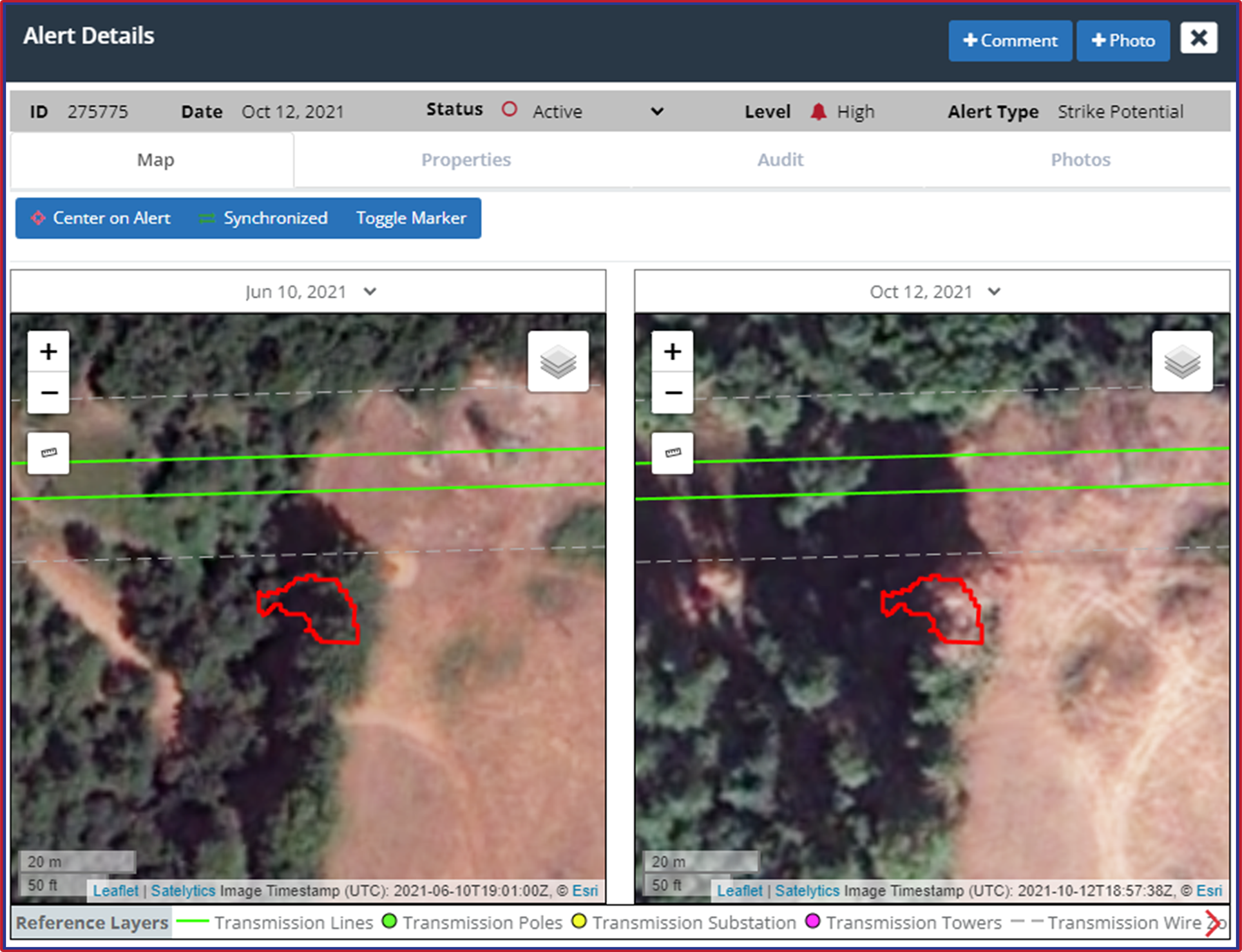
Spot strike risks outside the corridor, too.
Four Financial Ledgers
A credible business case should track four distinct value streams.
Avoided planned work. Quantify circuit miles or treatment units safely deferred because measured conditions remain below intervention thresholds. Apply the utility’s actual contractor rates (not a national benchmark) and subtract imagery, analytics, integration, and field-validation costs.
More productive work. Track planner hours, scouting miles, repeat visits, contractor mobilizations, invoice discrepancies, and completed work orders per crew-day. Satelytics can provide geolocated alerts and post-work verification, allowing crews to move toward identified threats rather than beginning with a search.
Avoided emergency cost. Capture overtime, trouble crews, line crews, vegetation crews, replacement materials, traffic control, and mutual-assistance costs attributable to vegetation events. These are utility cash costs and should be separated from customer economic impacts.
Avoided customer interruption cost. Berkeley Lab’s ICE 2.0 model illustrates why customer mix matters. For a two-hour interruption, its national modeled values are $0.09 per customer-minute interrupted for residential customers and $24 for non-residential customers, in 2023 dollars. Utilities should run their own customer composition, outage duration, timing, and reliability improvement through ICE rather than applying a generic value of lost load.
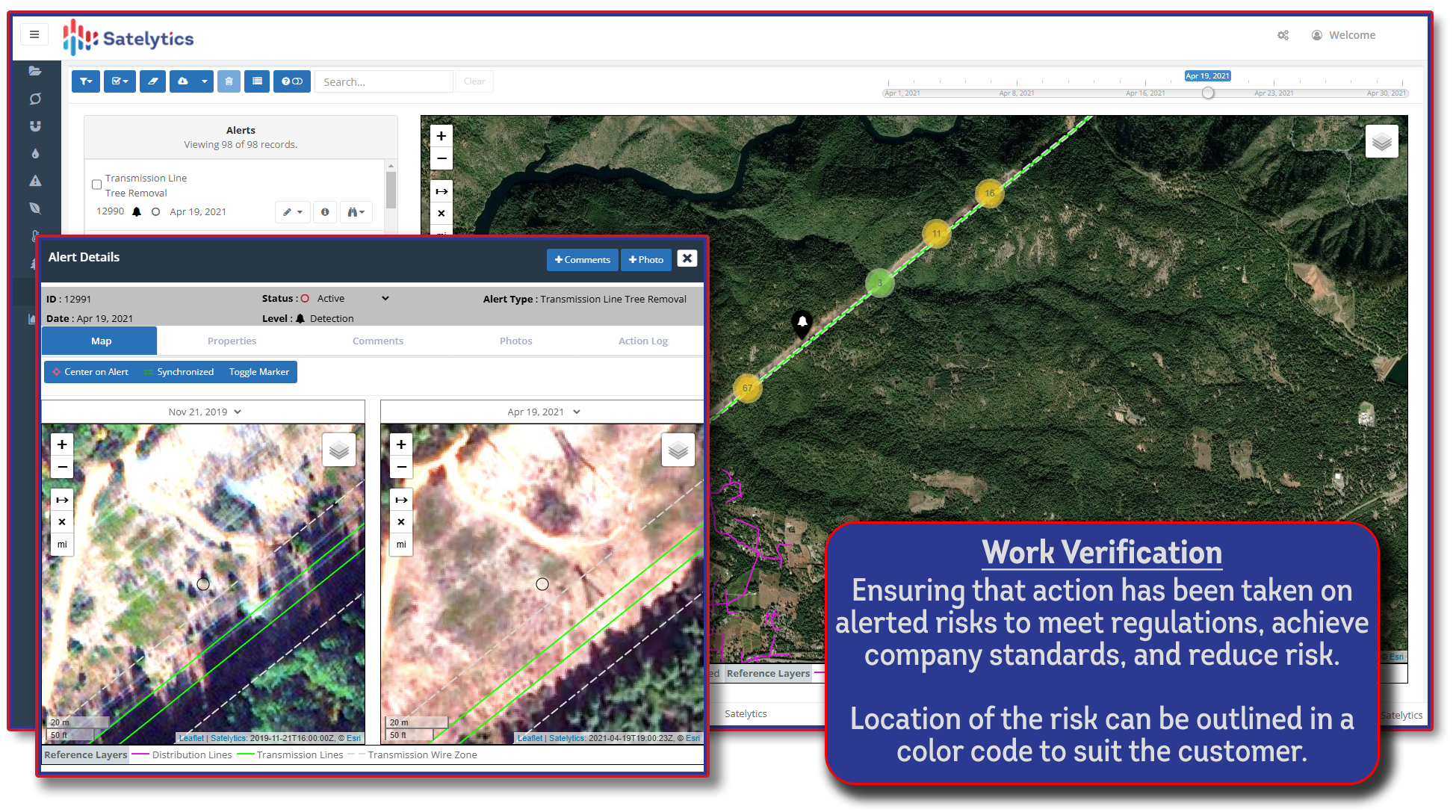
Work verification yields its own measurable productivity gains.
Regulatory and reliability value belongs in the model, too. NERC FAC-003-5 requires applicable transmission owners and generator owners to inspect applicable rights-of-way at least once per calendar year, with no more than 18 months between inspections, and to report qualifying sustained vegetation outages quarterly. More frequent condition intelligence does not replace required inspections, but it can improve prioritization, documentation, and the defensibility of decisions between them.
FirstEnergy Ohio estimated that an eight-year enhanced vegetation-management program would improve average SAIFI by 8% to 11% versus recent historical results. That is a forecast, not a realized guarantee, but it shows that utilities already present vegetation investments to regulators in reliability terms, not just acres treated or miles trimmed.
Change the Unit of Success
Satelytics’ circuit-risk analysis turns high-resolution imagery into a forward work plan. It measures tree health, height, canopy conditions, and species; applies standard or utility-specific growth models; and predicts which zones are likely to require intervention. The output can support multi-year budgets and bid packages, while individual alerts direct field teams to priority locations.
The most important management change is the scorecard. Replace “percent of cycle completed” as the dominant measure with risk retired per dollar: high-risk zones mitigated, predicted threats validated, emergency work avoided, customer minutes prevented, and low-risk work safely deferred.
A five-year cycle can remain a planning framework. It should no longer be mistaken for a risk model. The utility that reassesses frequently can spend less where vegetation is stable, act earlier where risk is compounding, and turn vegetation management from a recurring calendar expense into a measurable reliability investment.