
- Problem: Corridors change between patrols.
- Solution: Corridor-wide change detection.
- Benefit: Earlier, cheaper interventions.
According to a recent PHMSA advisory bulletin, a contractor leveling ground in 2025 for a concrete parking lot struck an interstate pipeline and released an estimated 2,363 barrels of crude oil. The contractor didn’t expect to dig deeper than 16 inches, so no one requested a line locate. The same PHMSA advisory bulletin describes a gas transmission line that ruptured from latent excavation damage where it crossed a recycling center using heavy equipment, and an intrastate gas line struck by a wheel loader at a cattle feedlot.
PHMSA’s diagnosis is blunt: “Most pipeline rights-of-way (ROW) are not secured. The landowners or tenants may conduct activities that are detrimental to the pipeline assets within the ROW.” Electric transmission and distribution corridors share the same exposure. People use that ground every day, and the operator often learns what changed at the next patrol, if even then.
That’s why encroachment deserves more than a line in a patrol report. It touches integrity, engineering, land rights, legal exposure, line capacity, and community relations at once. And unlike corrosion or vegetation growth, it runs on someone else’s schedule.
The Operator Is Often the Last to Know
The Common Ground Alliance (CGA) analyzed 196,977 damage reports from 2024 and found that failure to notify 811 remained the single largest root cause, at 24.54% of damages. Pipeline data is starker. The NTSB reviewed 300 excavation-damage incidents on pipelines from 2020 through 2025. Notification issues accounted for 33 of the 63 incidents on gas transmission and gathering lines and 26 of the 46 on hazardous liquid lines (more than half in both cases). INGAA, analyzing gas transmission data, reported that 63.4% of excavation-damage incidents occurred without prior notification to the operator.
The 811 process protects a buried line only when someone uses it. When the excavator, farmer, or developer never calls, the operator’s remaining defense is noticing the activity on the ground before the bucket reaches the pipe.
The Repair Bill Is the Smallest Line Item
In August 2026, CGA estimated that damage to buried utilities costs the U.S. economy $83.2 billion a year. Direct repair accounts for only 5.9% of that total; for every dollar spent fixing a damaged line, nearly $16 more is lost to impacts on businesses, communities, and the environment. Coverage of the study notes that excavation is increasing nationwide to support broadband, data centers, energy infrastructure, and housing. PHMSA warns that pipeline excavation incidents persist “particularly during times of economic growth and infrastructure expansion.” Since 2005, excavation-related pipeline incidents have caused 40 fatalities and 166 serious injuries.
Overhead Lines Have Their Own Version
When Southern Company contracted satellite encroachment monitoring with Satelytics, it described the typical case as accidental: a landowner misjudges the right-of-way boundary and builds a barn, parking lot, or other structure too close to a transmission line. If the problem isn’t corrected, the utility may have to downgrade the line so conductors don’t strike the structure as they sag or sway. That’s lost capacity, imposed by a structure the utility never approved.
Ohio Edison Co. v. Wilkes shows how long these conflicts can run. A homeowner installed an above-ground pool and a shed inside a 69 kV line easement in 1993. The pool sat 20.7 feet from the conductors where the National Electrical Safety Code (NESC) called for 25.7 feet; the shed sat 10 feet away where 13.2 feet was required. Ohio Edison sued in 2009. The courts ordered both structures moved, noting that they limited the utility’s ability to run the line at full power and acknowledging how hard it is to monitor miles of line across many properties.
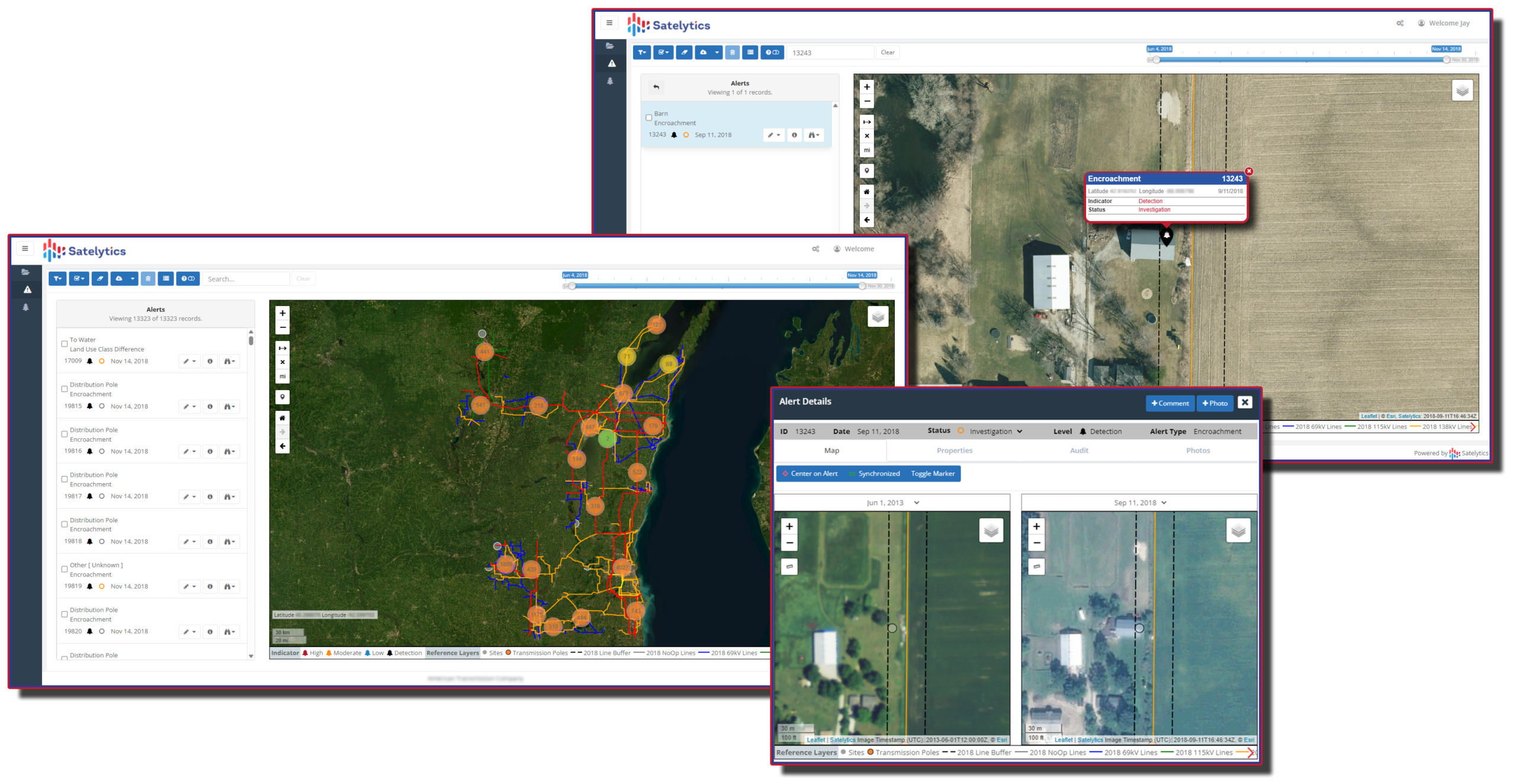
Encroachment within a transmission corridor.
Not every encroachment is a building. Dominion Energy’s transmission guidelines state that “all NESC violations within the Right of Way are Encroachments” and prohibit changes to topography or elevation without written approval. Transource Energy explains why: “Placement of fill dirt in the right-of-way reduces conductor-to-ground clearance.” The ground rises; the conductor doesn’t.
Distribution networks feel the pressure in dense neighborhoods. Austin Energy documented new structures inside the 7.5-foot clearance from primary conductors, contractors pushing a primary aside with 2x4s to erect scaffolding, and a case where contractors worked within the minimum approach distance and a non-qualified worker was electrocuted. The utility had issued more than 70 Notices of Electrical Hazard since 2017 and proposed a 15-foot radial clearance rule, citing a proliferation of accessory dwelling units. In OSHA data compiled by ESFI, overhead power line contact accounts for 49% of workplace electrical fatalities.
Time Works Against the Easement Holder
Encroachments also age badly. Burns & McDonnell notes that state statutes typically set periods of seven to 20 years within which a utility must respond to an encroachment. A utility that fails to enforce its easement gives the landowner an argument for keeping the encroachment and can potentially lead to the easement’s termination. Ohio Edison prevailed, but only after roughly 16 years and a lawsuit. The firm also reports that after monitoring budgets were cut, some utilities discovered “hundreds—sometimes thousands—of previously unidentified encroachments” along routes planned for upgrades, and it concludes that prevention costs far less than mitigation.
The Corridor Isn’t the Whole Story
Some of the most consequential changes happen just outside the easement. A gas transmission line’s class location depends on the number of buildings intended for human occupancy within 220 yards of the centerline along a one-mile stretch; 46 or more makes it Class 3. When development pushes a segment into a higher class, operators have traditionally reduced pressure, retested, or replaced pipe, and industry groups estimate they spend $200 million to $300 million a year replacing pipe for class changes. PHMSA’s January 2026 final rule adds an integrity-management alternative for certain segments moving to Class 3, observing that “areas with population growth typically require more, not less, gas.” Either path is easier to plan when the new subdivision shows up as cleared lots rather than finished rooftops.
Patrol Frequency Meets AI-Powered GeoAI
Federal rules require hazardous liquid operators to inspect right-of-way surface conditions at least 26 times a year, at intervals not exceeding three weeks. Gas transmission patrols occur one to four times a year, depending on class location and crossings. PHMSA’s pending proposal would add “observation or imaging from … satellite” to the accepted methods in both sections, provided the method captures current surface conditions.
That matters because encroachment usually starts as a surface change: cleared vegetation, graded soil, new access roads, stockpiled fill. In the Southern Company project:
- Satelytics analyzed 50 cm Pléiades imagery of transmission corridors every three months.
- Change-detection algorithms identified land disturbances that often precede construction, along with new barns, parking lots, pools, and houses.
- Alerts were delivered into Esri ArcGIS, and field feedback refined the analytics until they flagged only encroachments posing a danger to people or a problem for the utility.
In North Dakota, an oil and gas operator has used weekly Satelytics monitoring across its entire footprint since October 2022; the same dataset that detects liquid leaks also provides early warning of right-of-way encroachment.

Unauthorized vehicle on top of pipeline right-of-way.
The practical value is timing. A disturbance flagged before a foundation is poured leads to a conversation with a landowner. The same encroachment found years later can mean a removal demand, a line downgrade, or a courtroom. Each dated detection also adds to the documented record that consistent easement enforcement relies on.
For operators deciding where to start, high-growth corridors make a sensible test: run change detection across a full season and compare its findings with the last patrol reports. The gap between those two lists shows how much the right-of-way changes while no one is watching.