- Problem: Missed infrastructure faults.
- Solution: GeoAI monitoring.
- Benefit: Positive ROI, achieved quickly.
“Too expensive” compared to what? Many sales conversations eventually arrive at the same fork in the road. The prospect leans back, crosses their arms, and delivers the verdict: “It’s too expensive.” It’s a reflexive response, understandable, even predictable. But it deserves a harder look, because it contains a hidden assumption that doesn’t survive scrutiny: maintaining status quo has no cost.
The real question isn’t whether geospatial AI monitoring (GeoAI) is expensive. The real question is: expensive compared to what?
- Compared to a pipeline environmental remediation that can cost hundreds of millions of dollars?
- Compared to regulatory fines that routinely reach seven figures?
- Compared to the erosion of community trust that can shut down a company’s ability to acquire rights-of-way (ROWs) for the next decade?
- Compared to a wildfire liability that drives a utility into bankruptcy?
When those are the alternatives, “too expensive” begins to look like a wrong conclusion derived from wrong math.
The Amnesia Problem
There is a well-documented behavioral phenomenon at work in boardrooms and operations centers across the energy sector. Companies that have experienced costly incidents tend to quickly minimize their memory of those incidents. The engineering reviews conclude. The lawyers settle. The press moves on. And the cultural assumption reasserts itself: that won’t happen again.
This is selective amnesia, and it is ruinously expensive.
The Pipeline and Hazardous Materials Safety Administration (PHMSA) tracked over 12,300 pipeline incidents across a 20-year span (2000–2019), reporting more than $9.4 billion in total documented costs. That averages to roughly $471 million in annual incident costs across the industry, and that figure only captures what operators self-report. It does not include legal fees, reputational damage, or the downstream costs of delayed ROW approvals.
More telling: the three-year average cost of incidents from 2017 to 2019 alone was nearly $868 million per year. These aren’t rare, catastrophic outliers. They are a recurring cost of doing business that operators consistently underestimate, because human memory is not designed to hold onto risks that haven’t materialized recently.
The Real Ledger: What Inaction Actually Costs
Environmental Remediation: The Nine-Figure Trap
When a pipeline incident does occur, the remediation math is brutal. TC Energy’s Keystone Pipeline spill in December 2022 was estimated to cost approximately $480 million in cleanup and restoration. That figure does not include the civil penalty of more than $26.8 million subsequently levied against the company by EPA and DOJ, nor the additional $40 million in compliance investments required to prevent future discharges, nor Kansas’s $3 million in natural resource restoration.
Plains All American reported cleanup and restoration costs exceeding $53 million on a single Alberta leak. Belle Fourche and Bridger Pipeline faced a combined $12.5 million civil penalty for spills in Montana and North Dakota. In 2003, Colonial Pipeline paid $34 million (then the largest civil penalty in EPA history) plus a commitment to spend at least $30 million upgrading its system. Koch Industries paid $35 million in civil penalties related to more than 300 oil spills from its pipelines across six states.
These are not hypothetical scenarios. They are documented outcomes that unfold when signals go undetected.
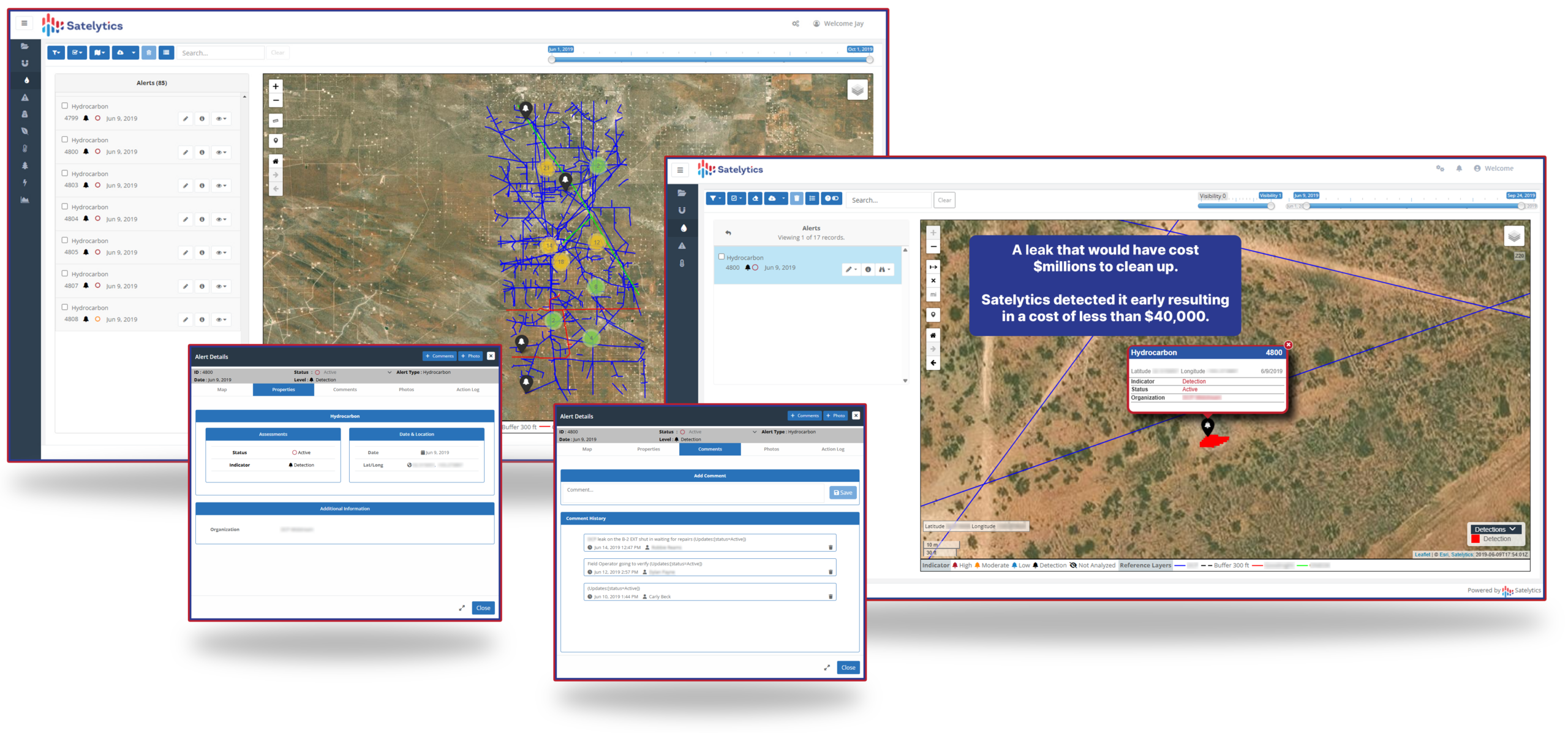
Liquid hydrocarbon leak alerted early, sparing $millions in pain.
Regulatory Fines: The Mounting Compliance Risk
Regulators are not becoming more lenient. Penalties for Clean Water Act violations, pipeline safety law breaches, and environmental damage are escalating. The settlements listed above represent the floor, not the ceiling, of what operators can expect when incidents occur and response is delayed.
PHMSA defines “significant incidents” as those involving fatalities, injuries requiring hospitalization, $50,000 or more in total costs (1984 dollars), or liquid releases of 50 barrels or more. Hundreds of such incidents occur annually. Each one opens the door to federal enforcement action, state-level penalties, and civil litigation that can persist for years.
Electric Utilities: When Infrastructure Becomes a Fire Starter
Electric utilities face a similar exposure. PG&E’s failure to adequately monitor and maintain its transmission and distribution infrastructure produced consequences that dwarf even the largest pipeline incidents. The California Public Utilities Commission levied $2.137 billion in penalties against PG&E for its role in the catastrophic 2017 and 2018 wildfires. The company ultimately settled wildfire claims totaling more than $25.5 billion, including a $13.5 billion fund for individual victims, and was forced into bankruptcy. Those fires were ignited by aging electrical equipment operating in areas where vegetation encroachment had gone undetected and unmanaged.
Gas Utilities: The Invisible Drain
For gas distribution operators, the calculus includes not only the risk of catastrophic incidents but also the ongoing, invisible cost of methane loss. Research from Resources for the Future found that U.S. natural gas distribution utilities are spending substantially less on leak detection and repair than the commodity value of the gas they’re losing — often less than $0.48 per thousand cubic feet (Mcf) on LDAR programs, against an average natural gas price of $5.67/Mcf.
Studies consistently show that fewer than 10% of leaks, so-called “super-emitters,” account for 50% or more of total network emissions. Identifying those leaks through continuous geospatial monitoring and prioritizing them for repair can reduce emissions by 80% or more, at a fraction of the cost of full-network manual inspection, a fact backed by the experience of one of Satelytics’ largest gas utility customers.

Methane measurement led to the identification of a small leak.
The Right-of-Way Dimension
There is a cost category that never appears on an incident report but can define the long-term trajectory of an energy company: the ability to secure future ROWs from private landowners.
Pipeline and electrical transmission routes require easements across private property. These negotiations depend entirely on trust. A company with a documented history of undetected leaks, equipment-caused wildfires, environmental damage, and poor community stewardship faces a fundamentally different negotiating environment than one with a proven record of proactive monitoring and rapid response. When negotiations fail, companies face the eminent domain process, with all of its legal costs, delays, and reputational exposure.
The goodwill required to secure future ROW is built over years and destroyed in a single incident. GeoAI monitoring is, above all, a trust asset. I can be a demonstrable commitment to early detection and responsible stewardship that operators can present to landowners, regulators, and communities as evidence that their infrastructure is being actively watched.
The Detection Speed Advantage
The financial case for early detection is not theoretical. Remote sensing technology applied to pipeline corridors has demonstrated the ability to identify anomalies days before operators receive confirmation through traditional monitoring systems. One documented case showed satellite-based detection of a pipeline release five days prior to the operator’s own knowledge of the incident. Five days of undetected flow in a significant incident represents millions of dollars in additional spilled product, expanded remediation zones, and compounded regulatory exposure.
The Equation That Changes the Conversation
Energy operators share a common financial reality: their infrastructure spans thousands of miles, operates in remote and variable terrain, ages continuously, and is subject to forces that do not wait for scheduled inspections. In most cases, this equation does not favor inaction. The annual cost of comprehensive GeoAI monitoring is a predictable, budgetable line item. The cost of the incidents it prevents is open-ended, unpredictable, and far larger.
The New Question to Ask
The question “Is this too expensive?” assumes that the status quo is free. It isn’t. It carries the accumulated cost of every signal that went undetected, every incident that escalated because response was delayed, every fine that was paid because documentation was absent, and every ROW that became adversarial because a community’s trust had been exhausted.
The question that leads to sound financial decisions is: What is the cost of the information I don’t have? For pipeline operators, oil and gas producers, electric utilities, and gas distribution companies, that question has a documented answer. It runs from millions to billions of dollars, depending on what goes wrong and how long it takes to find out.
GeoAI monitoring doesn’t just reduce risk. When measured against the full ledger of inaction, it improves the bottom line for operators willing to do the honest math.