- Problem: M&A-induced turbulence.
- Solution: Monitor-by-exception ops.
- Benefit: Free talent and capital to achieve synergies.
When the ink on an M&A deal dries, the real turbulence begins. 2024 continued one of the most active M&A cycles in U.S. upstream history: Enverus tracked $105 billion in deals (the third-highest annual total on record) coming off a record-setting $192 billion in 2023 that featured the Exxon-Pioneer and Chevron-Hess megadeals. The industry is now absorbing an unprecedented volume of newly combined operations teams. Boards promised “synergies,” but evidence of such is not universal. Operational friction is silently eroding headline economics.
That friction shows up in the field long before it reaches an earnings slide:
- Crew stability evaporates. EY’s People in Transactions research, validated by a joint EY/Oxford Saïd Business School study, puts average voluntary turnover at 47% in the first 12 months post-deal and 75% within three years, meaning roughly half your institutional knowledge walks before the first integration milestone closes.
- Safety lagging indicators deteriorate. Process safety research consistently links organizational transitions to elevated incident rates, as human factors temporarily dominate over engineered controls during the adjustment period. Loss-of-primary-containment events and recordable incidents tend to cluster in the 6–18 months immediately post-close, before new operating norms take hold.
- Environmental exposure balloons. PHMSA’s liquid-pipeline records reveal that 53% of spilled product contaminates soil and 41% reaches sensitive areas. The likelihood of incidents historically tracks workforce instability and operational unfamiliarity, which defines the post-M&A risk window. A single breach while crews learn “the new way” can vaporize years of touted cost synergies.
Why Traditional Integration Playbooks Fail in the Field
M&A manuals emphasize org charts, ERP cut-overs, and branding. Yet field performance is overwhelmingly determined by what happens outside the fence line, where spreadsheets can’t see defective flares or a valve weeping condensate. Two systemic gaps cripple integration teams:
- Talent Dilution. Losing half your experienced operators means the remaining half are driving unfamiliar roads, babysitting new pads, and reacting to work orders spun out of a system they just learned. Vehicle-incident frequency tends to rise post-merger, driven by drivers navigating unfamiliar route networks, learning new dispatch systems, and absorbing higher workloads with smaller crews. Process safety literature consistently identifies the transition period as a window of elevated human-factor risk, well before a combined organization has standardized procedures, trained personnel, or mapped its own road hazards.
- Data Myopia. Pre-deal diligence is asset-level and historic; post-close execution is component-level and real-time. SCADA latency, missing P&IDs, and paper-map routing turn HSE managers into blind pilots.
The Satellite-Based Geospatial Analytics Antidote
Today, commercial constellations offer 30-centimeter multispectral imagery, hyperspectral channels, and daily revisits. Add AI models trained on tens of thousands of labeled O&G anomalies, and you have a remote, always-on control tower for a basin you just bought but haven’t fully mapped.
- Leak Detection & Quantification. A Satelytics customer has proven the math: multispectral analytics flagged a produced-water leak 13 days earlier than ground patrols would have. Since then, this same customer has monitored ≈4,000 square miles, preventing multiple multimillion-dollar remediation efforts, regulatory fines, and untold headaches with landowners. Cleanup and remediation costs for pipeline incidents vary enormously depending on release volume and location, but even moderate spills routinely generate seven-figure liability. PHMSA enforcement actions and consent decrees regularly involve penalties in the $1M–$35M range before remediation costs are added, illustrating why a single breach during the integration window can eliminate a year’s worth of projected synergies.
- Emissions & Methane Fee Avoidance. Permian methane intensity has dropped more than 50% in just the past two years, with 2024 intensity reaching 0.44% per barrel of oil equivalent — part of a broader multi-year decline driven by more than $300 billion in industry-wide emissions-mitigation investment over the past two decades. Yet a small fraction of facilities — the sporadic super-emitters — account for approximately 50% of total basin methane emissions, according to Carbon Mapper aerial surveys and independent research. LDAR directed by Satelytics lets crews prioritize those handful of rogue sites where intervention returns the highest ROI per hour dispatched.
- Crew Utilization & Safety. Overlaying weekly leak alerts with GPS telematics optimizes routing. An operator harnessing the service can reduce average windshield time by more than 20%, thereby trimming diesel expenses and decreasing vehicle incidents in proportion to the miles driven. For a 150-truck Permian fleet, this translates to millions of dollars per year in fuel and maintenance savings, not to mention a lower total recordable incident rate (TRIR).
- Integration Speed. Chevron’s Hess acquisition illustrates what aggressive integration timelines now demand: the company targeted full operational integration within 45 days of deal close. Meeting that kind of timeline requires having a baseline view of every acquired asset before crews arrive, knowing where the wells are, what the flowlines look like, and where anomalies already exist. Remote sensing is built for exactly that kind of pre-integration reconnaissance, turning an unknown acreage position into a mapped, monitored baseline before a single survey truck rolls.
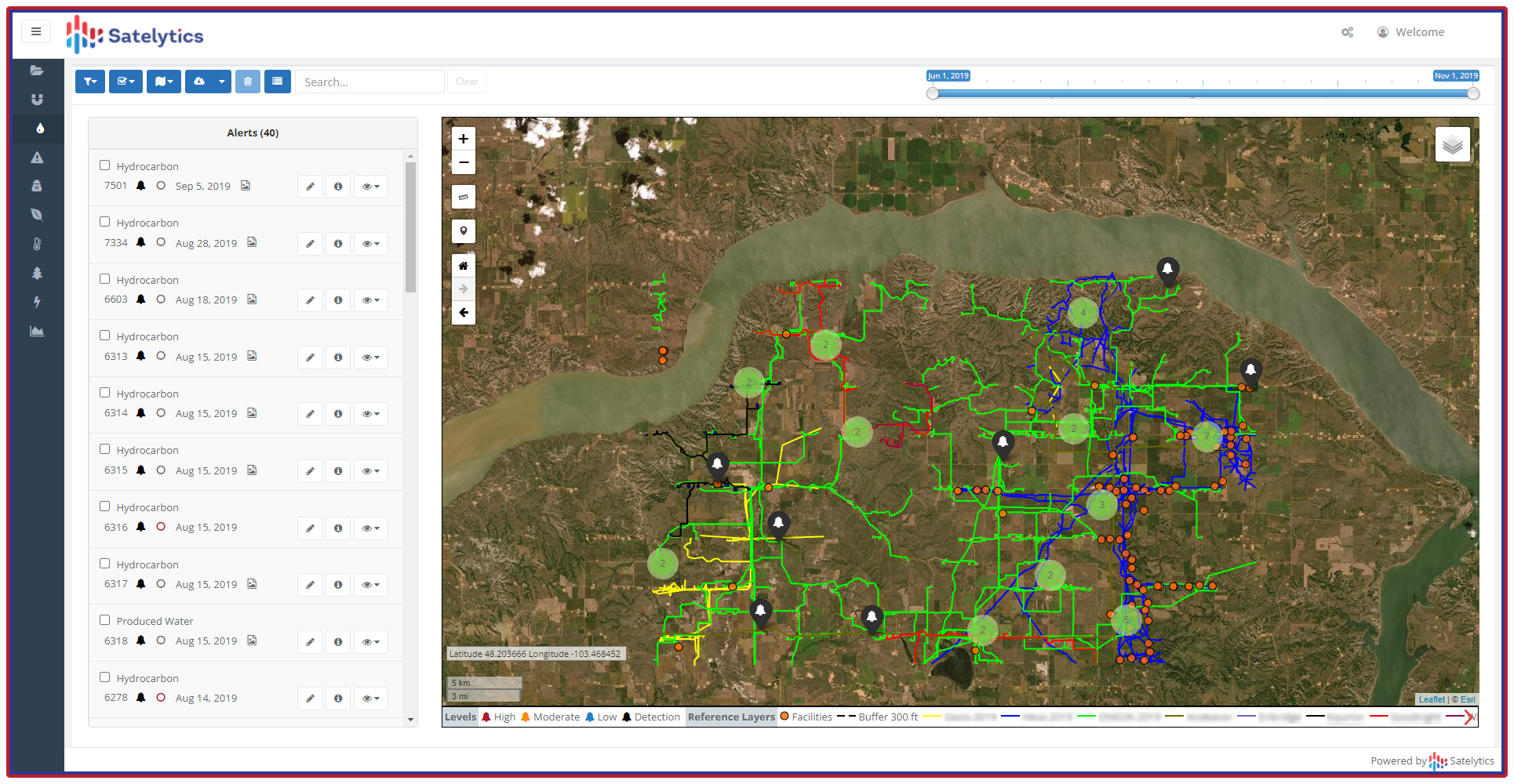
As new assets are onboarded, simply expand the AOI to ensure complete monitoring.
Building the Business Case
The following illustrative model applies documented performance benchmarks (Satelytics’ own customer case studies combined with published M&A risk data) to a hypothetical mid-cap operator (60 mbopd, 70% Permian exposure) to size the opportunity. The production deferment benefit reflects the revenue value of 40% faster fault identification applied to estimated downtime volumes.
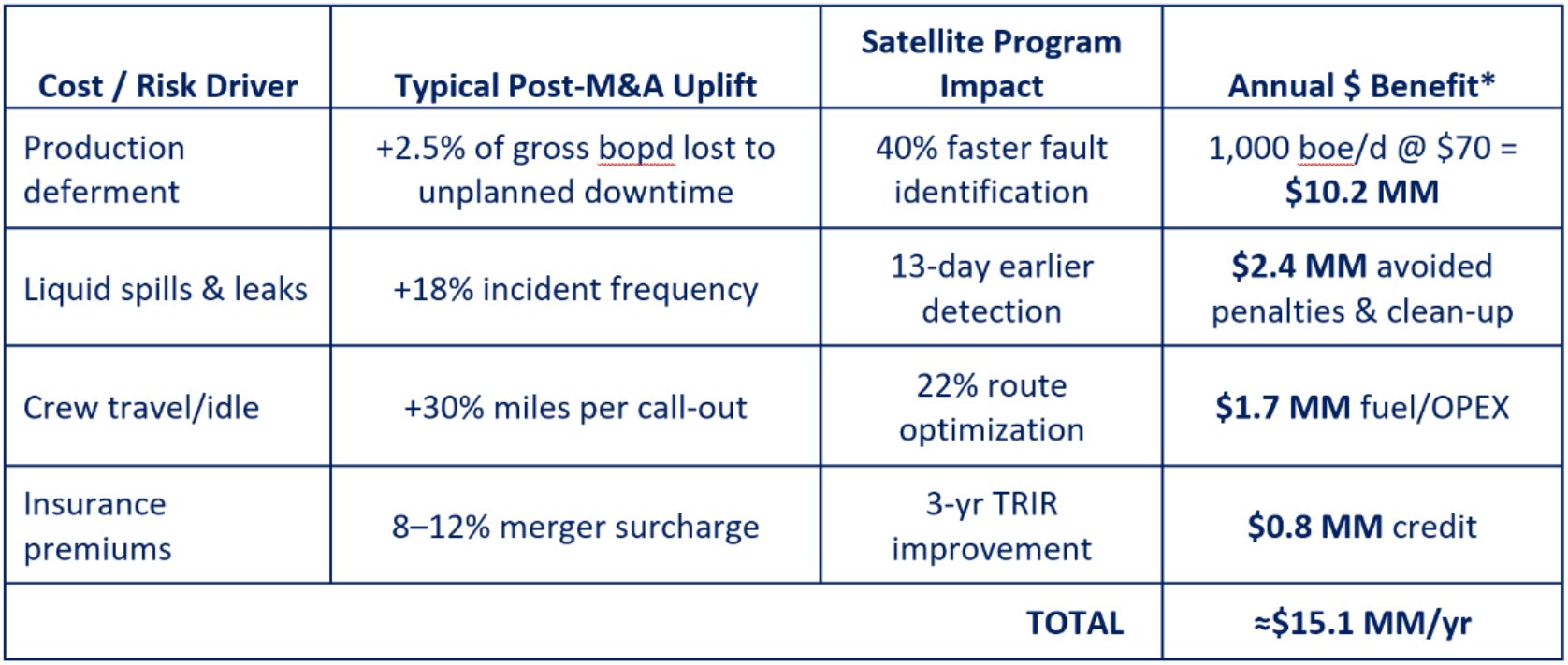
* Illustrative model. Mid-cap operator, 60 mbopd, Permian exposure 70%. Production deferment benefit reflects revenue recovered by 40% faster fault identification applied to estimated downtime volumes — not gross at-risk production value.
Even after adding an enterprise license for multi-constellation imagery (≈US $3 MM/yr), the payback period is under 100 days for a mid-cap operator carrying typical post-merger pain.
You cannot integrate what you cannot see. A satellite-powered control tower transforms a chaotic patchwork of new leases and unfamiliar crews into a quantified, monitor-by-exception operation — freeing talent and capital exactly where synergies were intended to emerge. Call us today to explore this in more depth.